Most clients don't quit because the program stopped working. They quit because they stopped feeling the progress. Gamification is one of the simplest ways to fix that, and done well it's a real lever for adherence and client retention. Done badly, it rewards exactly the behavior you spend your coaching trying to undo.
Here's what gamification actually is, what the research says, and how to use it in a coaching business.
What is gamification in fitness?
Gamification means using elements from games, like points, levels, streaks, badges, milestones and a social layer, in something that isn't a game. In fitness and nutrition coaching, that something is the boring middle: the third week of logging food, the fortieth session, the check-in nobody feels like filling out.
It isn't about turning training into a video game. It's about making progress visible while it's still too small to see in the mirror. Anyone who has coached in a gym has watched what a name on the PR board does for someone. Gamification puts that moment in your client's pocket, and makes it happen more than once a quarter.
Does gamification improve adherence?
The evidence says yes, with some honest limits.
- A 2022 meta-analysis of 16 randomized controlled trials (2,407 participants) in the Journal of Medical Internet Research found gamified interventions had a small-to-medium effect on physical activity, roughly 1,600 more steps a day. The effect was weaker in the months after the interventions ended, but it didn't disappear.
- In the STEP UP trial (JAMA Internal Medicine, 2019) of about 600 adults, every gamified group (points and levels plus support, collaboration or competition) walked more than people who only had goals and a wearable. The competition group added 920 steps a day, and still walked 569 more a day three months after the game ended.
Two takeaways for coaches. Gamification supports a good program; it doesn't replace one. And the social piece matters: in STEP UP, the game worked best when other people were part of it.
Why it works, and when it backfires
Gamification works because it shortens the feedback loop. Real results take months. A streak, a badge or a level-up shows up this week, and it tells the client the same thing you would: keep going, it's working.
It backfires when it rewards the wrong behavior. Here's what to watch for:
- Rewarding intensity over consistency. Badges for crushing yourself teach clients to ignore recovery.
- Rewarding less food. A "stayed under your calories" streak quietly rewards undereating.
- Rewarding the scale. Weight-loss badges make a bad week feel like failure and ignore the client who's recomposing.
- Public leaderboards for everyone. Some clients love competition. Others will quietly stop logging rather than sit at the bottom.
- Streaks that only punish. If missing one day wipes out three months, a single missed day can turn into a missed month.
How to use gamification for client retention
Whatever tools you use, these principles keep gamification on your side:
- Reward consistency, not heroics. Sessions per week, check-ins completed and days logged beat max effort every time.
- Make comebacks count. The client who returns after two weeks off deserves a win, not a reset to zero.
- Reward smart decisions. Scaling a workout on a bad-recovery day is good training. Celebrate it.
- Measure clients against themselves. Their own baseline, their own PRs, their own trend, never someone else's numbers.
- Let clients cheer each other on. Giving encouragement builds as much commitment as getting it.
- Acknowledge it yourself. A badge is nice. Their coach noticing the badge is what sticks.
How MetabolicHQ does gamification
I built gamification into MetabolicHQ around those rules, because I've seen what the wrong kind does to clients.
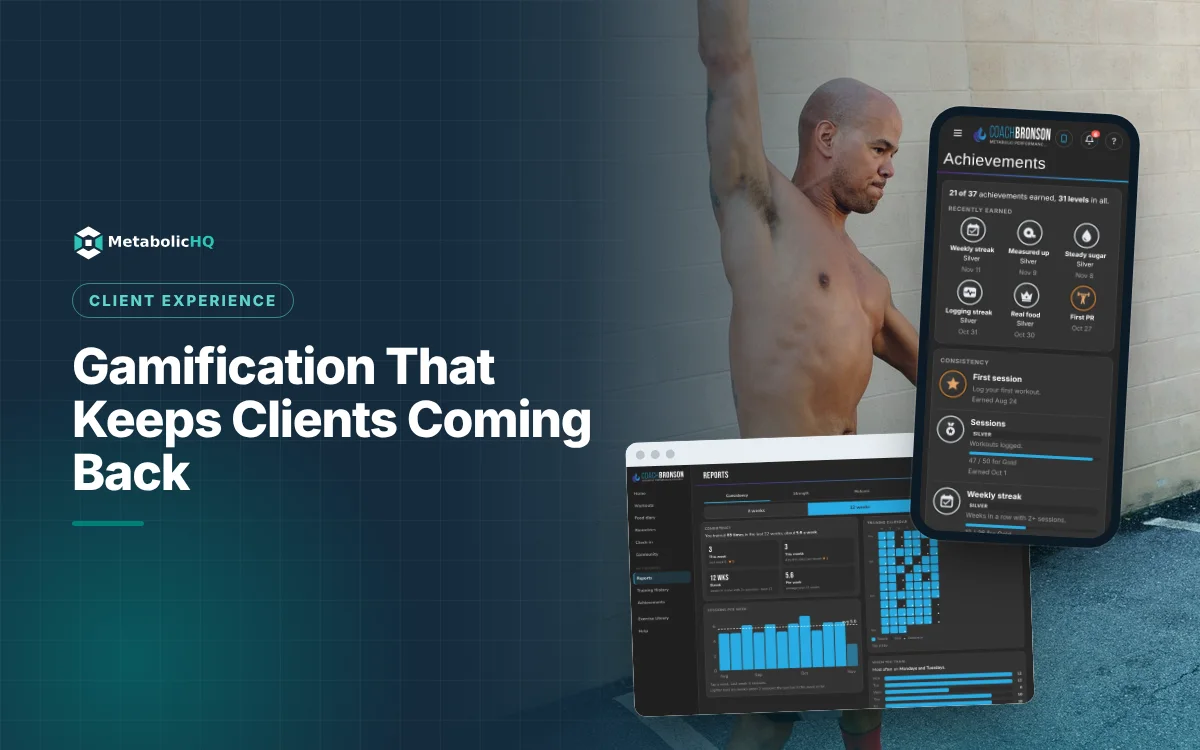
Clients earn achievements with Bronze to Diamond levels for consistency (sessions, weekly streaks, perfect months), strength (PRs), metcons (moving from Scaled to Rx, beating a benchmark), recovery habits, nutrition and biometrics. A few are deliberately different: there's one for coming back after time off, and one for scaling a workout on a low-readiness day. Nutrition targets only count when they're hit within 5% either way, so eating well under a target never earns anything. Biometric achievements are measured against each person's own baseline, and nothing is awarded for weight loss or hitting a number.
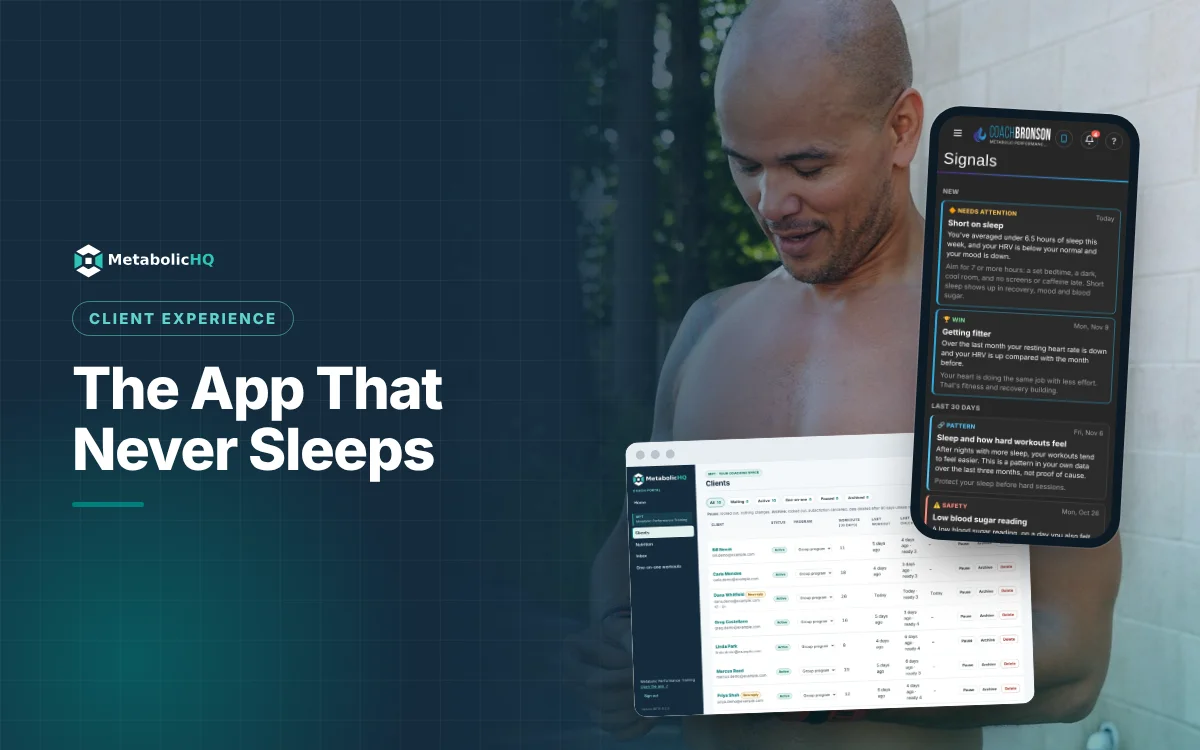
Achievements are private: clients see their own, and you see each client's from their log. If you switch on Community for your space, clients can give each other kudos and reactions, and there are badges for cheering other people on. There are no public leaderboards. And the app's Signals celebrate wins too, like getting fitter, body recomposition or a consistency streak, so the good news reaches both of you. (More on what the app notices for you in What Your Spreadsheet Can't See.)
All of it is included on every plan, including the free one for up to 5 clients.
Make progress visible
Clients stay when they can see that the work is working. Gamification, done right, is just a way of making that visible every week instead of every quarter, and giving you more reasons to tell a client you noticed.

Coach BronsonFounder of MetabolicHQ. 20 years coaching human performance and nutrition, 25 in IT engineering and program management. More about me
Try it with your own clients
MetabolicHQ is free for up to 5 clients: training, low-carb nutrition, biometrics and coaching calls in one app under your brand.
Start free